
What Thickness Should a Corten Steel Water Feature Be
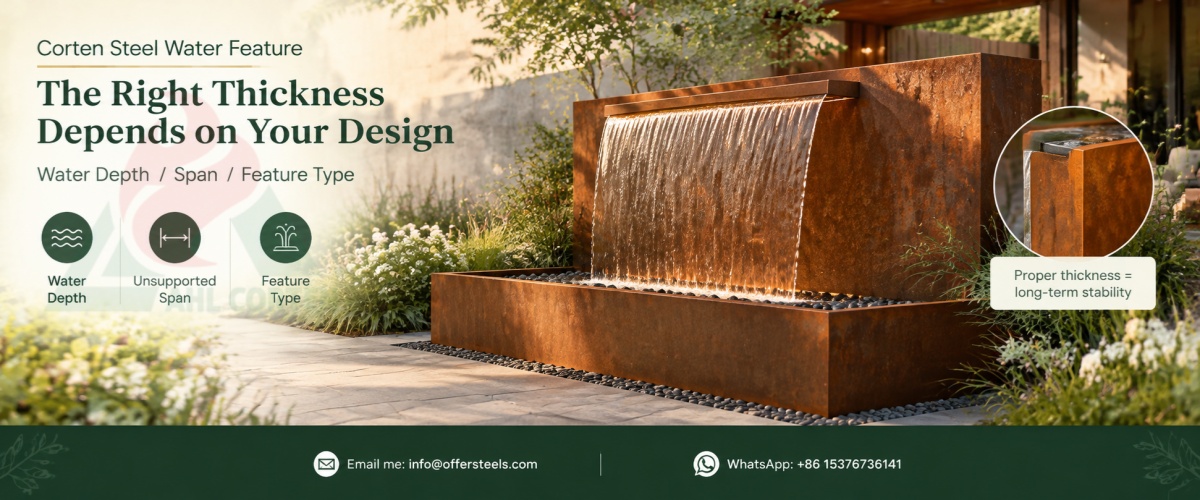
In garden landscape design, corten steel water fountains have become a popular choice thanks to their distinctive rusted texture.However, when making a purchase, many clients simply enquire about a fixed sheet thickness, overlooking structural risks; this can easily lead to problems such as sheet deformation and uneven water flow later on.
Many people ask: when building a corten steel waterfall, what is the appropriate thickness for the steel sheet?
The key point of this article is that there is no single, fixed thickness. The specifications of the steel plates depend on the water depth, the span of unsupported panels and the type of water feature. Do not focus solely on a single millimetre measurement; instead, make a comprehensive assessment based on the drawings and installation conditions.
By the end of this article, you will have mastered the key criteria for material selection, the potential hazards of using thin steel plates, and how to request complete technical specifications from suppliers.
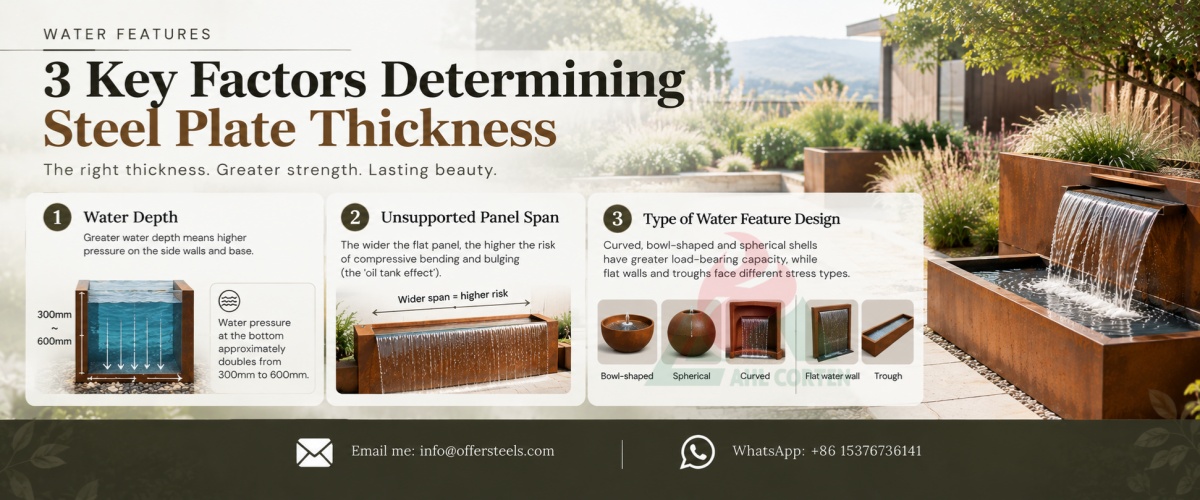
Water Features: 3 Key Factors Determining Steel Plate Thickness
Plate thickness is not selected based on experience alone; it is determined by the following three factors.
· Water depth: This determines the pressure exerted by the water on the side walls. As the water depth increases from 300 mm to 600 mm, the water pressure at the bottom approximately doubles, resulting in greater loads on the base and the lower half of the side walls.
· Unsupported panel span: The wider the flat panel, the more susceptible it is to compressive bending and the formation of bulges and dents (the ‘oil tank effect’).
· Type of water feature design: Curved, bowl-shaped and spherical shells have greater load-bearing capacity; whereas flat water walls and troughs are subjected to entirely different types of stress.
| Water Feature Type | Primary Load Factor | Details to Confirm with the Supplier |
|---|---|---|
| Water Bowl / Spherical Water Feature | Load pressure on the curved shell. | Shell plate thickness and base plate thickness. |
| Cascading Feature / Spillway Outlet | Spillway stiffness to maintain an even water flow. | Detailed spillway drawings and plate material thickness. |
| Water Wall / Long Trough Panel | Unsupported span and water depth. | Panel thickness specified for the required span. |
Note: The table above is provided for selection purposes only; the final thickness must be determined in accordance with the supplier’s drawings and the results of structural verification.
Corten Water Features: Why is Panel Thickness Crucial?
1. Water Pressure Distribution: Greater Loads at the Bottom
Water pressure increases with depth. The bottom of the water feature and the lower sections of the side walls are subjected to water pressure far greater than that at the top edge.
Under the same water depth conditions, wide flat panels are more prone to bending deformation. Even with the same thickness, the risk of deformation varies significantly depending on the panel support method.
2. Weathering Steel ≠ Stainless Steel
Weathering steel is a type of steel designed to weather; it is not entirely rust-proof.
Water features are subject to prolonged, continuous immersion, which is entirely different from ordinary outdoor atmospheric exposure. In environments of continuous damp immersion, the effects of long-term damp corrosion must be considered at the design stage; the thickness standards for ordinary landscape steel plates cannot be directly applied.
Matching Corten Steel Sheet Thickness to the Type of Water Feature
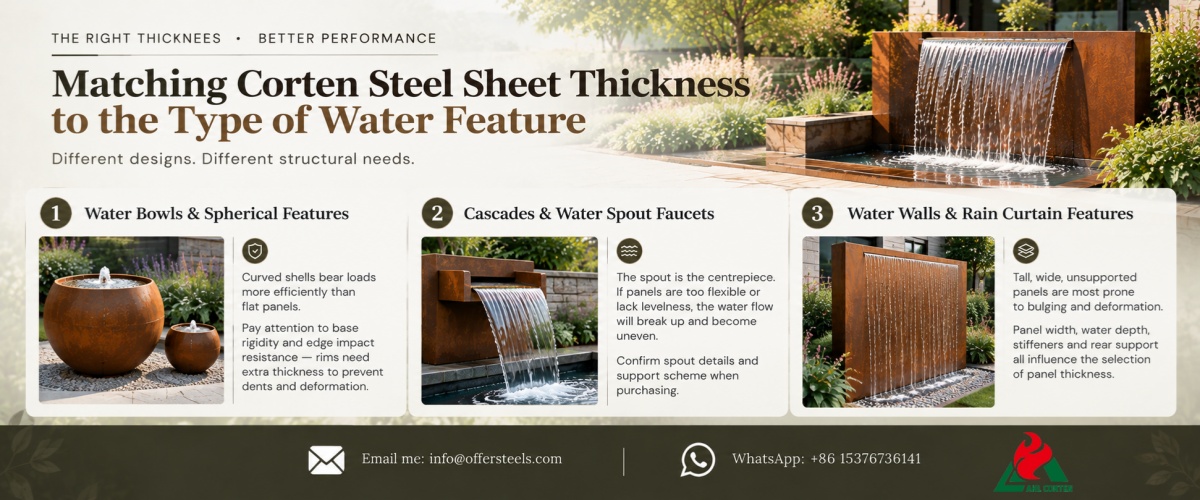
Water features made of weathering steel with different designs have entirely different points of structural weakness, and the areas requiring increased thickness also vary.
1. Water Bowls and Spherical Water Features
Curved shell structures are more efficient at bearing loads than wide, flat panels.
Particular attention must be paid to the rigidity of the base plate and the impact resistance of the edges. As they are prone to knocks in gardens, the rim edges require sufficient thickness to prevent deformation or denting.
2. Cascades and Water Spout Faucets
The spout is the centrepiece of the entire water feature. If the spout panels are too flexible or lack sufficient levelness, the water flow will break up and be unevenly distributed, preventing the formation of a smooth, continuous water curtain. When purchasing, it is essential to confirm the spout details and the support scheme.
3. Water Walls and Rain Curtain Water Features
Tall, wide, unsupported panels are most prone to visible bulging and barrel-like deformation.
Panel width, water depth, stiffeners and rear support all directly influence the selection of panel thickness.
When Purchasing Corten Water Features, You Must Confirm 3 Parameters With the Supplier
Providing only a single figure for sheet thickness constitutes an incomplete technical specification. Before placing an order, you must request the following three sets of information:
1. Shell / side wall panel thickness: Confirm whether this is a nominal thickness or a guaranteed minimum thickness. Panel tolerances must be verified against product standards, such as the ASTM A588 or EN 10025-5 weathering steel standards.
2. Base plate thickness: As the base plate bears greater water pressure, many designs feature a thicker base plate than the side walls or incorporate additional reinforcement. It is necessary to confirm separately whether the base plate and side walls utilise different specifications.
3. Unsupported span corresponding to this thickness: This refers to the maximum panel width permitted by the manufacturer under the specified water depth and support arrangement. Thickness, span and water depth must be considered in conjunction.
Additional checks: Verify whether the pump chamber, fasteners and the lining in contact with the water are made of the same grade of weathering steel.
Thin vs. Thick Corten Steel: Risks and Trade-Offs
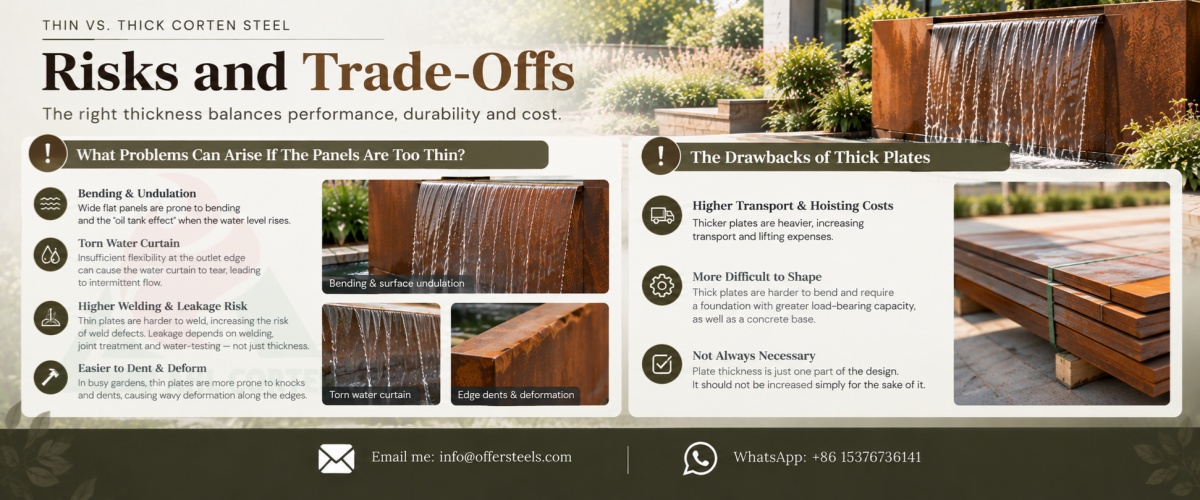
What Problems Can Arise If The Panels Are Too Thin?
When the water level rises, wide flat panels are prone to bending and surface undulation (the ‘oil tank effect’).
Insufficient flexibility at the water outlet edge can cause the water curtain to tear, resulting in intermittent water flow. Thin plates are more difficult to weld, increasing the risk of weld defects. Leakage does not depend solely on plate thickness; welding techniques, joint treatment and water-testing are equally critical. Thicker steel plates do not guarantee absolute leak-proofing.
In freestanding water basins situated in busy gardens, thin plates are more prone to knocks and dents, resulting in wavy deformation along the edges.
The Drawbacks of Thick Plates
Increasing plate thickness leads to a heavier overall structure, resulting in higher transport and hoisting costs. Thick plates are more difficult to bend into shape and require a foundation with greater load-bearing capacity, as well as a concrete base.
Plate thickness is one aspect of the overall design and should not be increased simply for the sake of it.
Site Conditions Dictate the Thickness Requirements for Water Features
Steel plates of the same specification will exhibit completely different load-bearing behaviour depending on the installation method.
The selection criteria for steel plates differ between water features placed freestanding on a terrace and troughs supported by backfill on the outer side.
A level foundation with adequate load-bearing capacity is essential. Should the foundation settle, the distribution of water flow will become disrupted, appearing as a product quality defect.
Manufacturers must be informed in advance of special environmental conditions:
· Extremely cold regions: Prioritise drainage and winter frost protection; frost-proof design is independent of plate thickness
· Coastal salt-fog environments and chlorinated water bodies: These will alter material selection and long-term maintenance plans
Obtain Customised Technical Specifications for Water Features
Contact us to receive a bespoke weathering steel water feature solution based on your site dimensions, designed water depth and installation conditions, including recommended plate thicknesses and complete drawing specifications
Want the Latest Catalog for Corten Steel Water Features? Contact Us!
Frequently Asked Questions (FAQ)
Q1: Is a 2mm-Thick Corten Steel Plate Sufficient for Constructing a Water Feature?
There is no one-size-fits-all answer. It depends on the size of the water feature, the water depth, the span of the panels, the supporting structure, the weld design and the operating environment. Do not base your decision solely on thickness; be sure to consult the relevant design drawings.
Q2: Does a Thicker Corten Steel Panel Guarantee That a Water Feature Will Not Leak?
No. Thickness primarily enhances the panel’s rigidity and durability; it cannot guarantee absolute watertightness. The quality of the welds, joint treatment, the positioning of cut-outs, the lining and hydrostatic testing are the key factors in preventing leaks.
Q3: Does the Base Plate of a Water Feature Necessarily Have To Be Thicker Than The Side Walls?
Not necessarily. The base plate is subjected to different stresses than the side walls; whilst some designs involve thickening and reinforcing the base plate, other structural solutions are also possible. Please ask the supplier to specify the thicknesses of the base plate and side wall panels separately, and to outline the support scheme for the base plate.
Home & Garden
- BBQ grill
- corten steel metal planter for outdoors
- garden bollards lights
- garden screens
- steel tree grates
- fire pit
- garden sculptures and statues
- garden water fountain
- garden edging
- bio ethanol fireplace
- Corten Fence Panels
- Corten Steel Water Features Manufacturers, Suppliers, Factory & Exporters | AHL Group
- Corten Steel Gardening Products
- Corten Steel Garden Edging
- Metal Gas Water Fire Fountain
- Corten Exterior Cladding
Mild Steel
Stainless Steel
Aluminum Sheet
Steel Processing & Services
News



 Get a quote, Now!